
Disabled Young Adults After 19: Wales Needs to Treat NEET Risk as a Prevention Crisis
Four in ten disabled 19 to 24-year-olds in Wales were not in education, employment or training in the three-year period ending December 2025.
That is the figure we need to sit with.
Not four in ten young people with “low aspirations”.
Not four in ten young people who “just need resilience”.
Four in ten disabled young adults.
Welsh Government’s latest NEET release says disabled young people are far more likely to be not in education, employment or training than non-disabled young people. The gap becomes especially stark after 19 [1].
For disabled 16 to 18-year-olds, the NEET figure was 18.6%.
For disabled 19 to 24-year-olds, it was 40.0%.
The release uses Annual Population Survey data, and Welsh Government is clear that APS estimates are more timely but less statistically robust than the annual Statistical First Release. There is also a specific quality caution around the disabled 16 to 18 figure because of sample size [1].
But even with that caution, 40.0% for disabled 19 to 24-year-olds is too serious to brush aside.
This figure should not be used to blame disabled young adults or their families. It should be used to ask whether the route around them is accessible enough to work.
At Learn Without Limits CIC, we think Wales needs to ask a harder question.
What is happening between school-age support, post-16 transition, further education, adult services, employment support and real life that means so many disabled young adults are being lost?
This article is written for families, professionals, policymakers and partners in Wales. It is not an attack on one service or one sector. It is a call to look honestly at the route young people are being asked to travel.
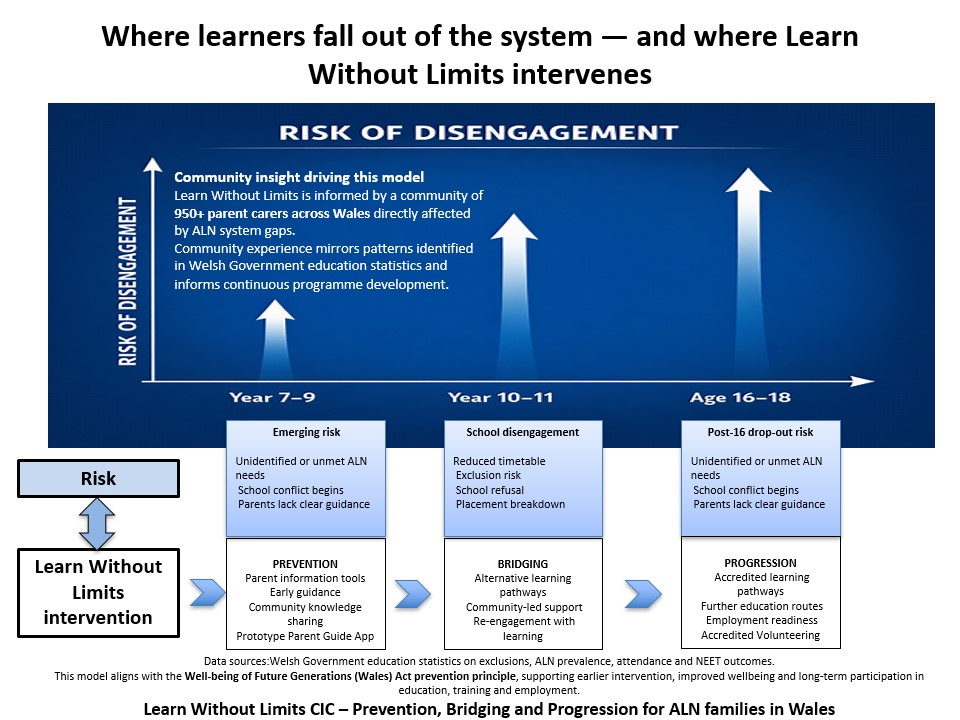
The warning signs start before 16
The problem does not begin at 19.
Welsh Government research using linked administrative data looked at children who could not be found in state education records. This data must be handled carefully. It may include children in independent schools, electively home-educated children, children educated in England, data-linkage issues and other explanations [2].
So this should not be described as a simple “dropout rate”.
But the age pattern is still important.
The estimated proportion of children with no PLASC/EOTAS record, or who had previously been recorded in PLASC/EOTAS but were not recorded on the census date, increased with age. It reached 8.1% at age 15 [2].
That does not prove every child in that group has dropped out of education.
But it does show a warning pattern near the end of compulsory school age.
For many families around Learn Without Limits CIC, this fits what parents describe: school anxiety, burnout, attendance collapse, placement breakdown, unmet Additional Learning Needs (ALN), education otherwise than at school (EOTAS) confusion, elective home education under pressure, and young people reaching 15 or 16 with confidence already badly damaged.
By the time the system starts talking about NEET prevention, some young people have already been disconnected for years.
A visual warning sign
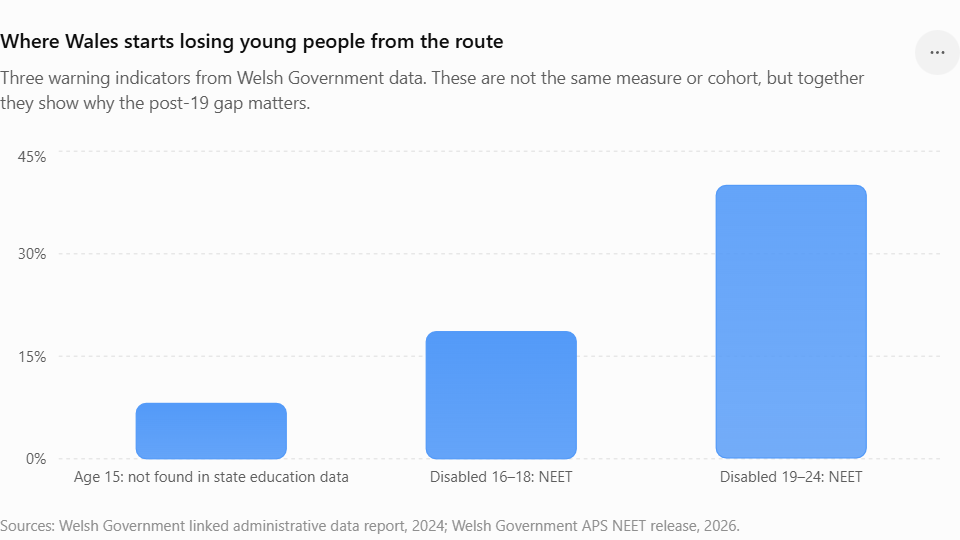
These figures are not a single cohort and they do not measure exactly the same thing.
But placed together, they show why Wales needs to look hard at the post-16 route:
- age 15: 8.1% not found in state education data in the linked-data estimate;
- disabled 16 to 18-year-olds: 18.6% NEET;
- disabled 19 to 24-year-olds: 40.0% NEET.
This is not proof that every young person in the first group becomes NEET later.
It is a warning line.
Wales can see the risk building before 16, see the elevated risk at 16 to 18, and then see the stark disconnection figure after 19.
If we can see the pattern, we should not wait for families to hit crisis before asking what support is missing.
| Stage in the route | Indicator |
|---|---|
| Age 15, not found in state education data | 8.1% |
| Disabled 16 to 18-year-olds, NEET | 18.6% |
| Disabled 19 to 24-year-olds, NEET | 40.0% |
The 16 to 18 figure matters, but the 19 to 24 figure is the alarm bell
At 16 to 18, disabled young people in Wales are already at higher risk of being NEET.
Welsh Government’s 2025 APS release says 18.6% of disabled 16 to 18-year-olds were NEET in the three-year period ending December 2025 [1].
That is serious.
But the 19 to 24 figure is worse.
40.0% of disabled 19 to 24-year-olds were NEET [1].
That suggests something is happening after school age and after the first post-16 transition window. The system may still be able to name “support” on paper, but too many young adults are not reaching education, employment or training in practice.
That matters because 19 is often where the landscape changes.
School structures fall away.
Some young people leave college.
Some never make it into college.
Some are no longer seen as children, but are not properly supported as adults.
Some do not meet adult social care thresholds.
Some are too anxious, burnt out or unsupported for standard employability schemes.
Some have qualifications but no confidence.
Some have skills but no pathway.
Some have support needs that do not fit tidy programme criteria.
Families can find themselves holding everything together with less structure than before.
That is not a transition.
That is a cliff edge.
This figure may not show the whole picture
There is another caution we need to name.
The 40.0% figure is shocking, but it may still not show the full picture of disabled young adults outside meaningful education, employment or training routes.
The Welsh Government figure comes from the Annual Population Survey. The APS is a household survey carried out by the Office for National Statistics [1]. The ONS Labour Force Survey quality and methodology information also explains that the LFS omits communal establishments, except for limited categories such as NHS housing and students in boarding schools and halls of residence [11].
That means some young adults with severe learning disabilities, including some living in residential care or other communal settings, may not be represented in the same way.
There is also a deeper policy issue.
For some young adults with severe learning disabilities, the expected route after school is not FE, training or work. It may be adult day services, residential care, supported living, or long-term care and support.
Those routes may be necessary and appropriate for some people. They should not be devalued.
But we still need to ask what this means for how Wales measures post-19 outcomes.
If the main public conversation focuses on education, employment and training, where do we see the young adults whose route is care, support, community life, communication, independence, safety, dignity and meaningful daily activity?
And for those who could learn, train, volunteer, work, contribute or progress with the right support, how do we know whether they are being offered a real route or quietly written off?
FE capacity is now part of the risk
This is why ColegauCymru’s June warning matters.
College leaders have warned that Welsh colleges face a £30 million funding shortfall from September, while also seeing record course applications [3].
That is not only a college-sector budget story.
It is a disabled young people and ALN transition story.
If further education (FE) capacity tightens while demand rises, who is most likely to lose out?
Often it will not be the confident learner with strong GCSEs, stable attendance, easy transport, clear support from home and a straightforward application.
The learners at risk are more likely to be those who need flexible entry points, smaller steps, supported transition, accessible transport, ALN-aware staff, mental health support, confidence rebuilding, part-time routes, practical courses, or time to recover from school breakdown.
That includes:
- disabled learners;
- autistic learners;
- young people with ALN;
- young carers;
- young people coming from EOTAS;
- home-educated young people;
- young people with long-term non-attendance histories;
- young people recovering from burnout, trauma or anxiety;
- young people whose learning route does not fit a standard full-time timetable.
If colleges are forced to restrict provision, the system must be honest about who gets squeezed first.
This is happening while the ALN system is already under strain
FE pressure is not happening in a vacuum.
Audit Wales has warned that the ALN system in Wales faces sustainability challenges. It found that public bodies do not have a complete picture of ALN demand, workforce capacity and skills, costs or outcomes. That means the system does not have enough information for effective planning, budgeting or assessing value for money [4].
Audit Wales also reported that identifiable annual spending on ALN is approaching £1 billion, with the true cost likely to be higher [4].
Welsh Government’s latest budgeted ALN expenditure release says local authorities have budgeted £764 million for school ALN provision in 2026 to 2027, up £96.3 million or 14.4% on the previous year [5].
So Wales is already spending more.
But spending more does not automatically mean the route is working.
If demand, complexity, outcomes, workforce capacity and costs are not clearly understood, then post-16 and post-19 planning becomes even more fragile.
Families experience this as one journey.
Policy does not.
Education, health, social care, FE, employment support, youth work, benefits, transport and community support can all hold separate pieces of the picture. But the young person only has one life.
If that life falls between the systems, everyone can say they did their bit while the family is left with the consequences.
The disability employment gap does not magically close after 25
The 40.0% disabled 19 to 24 NEET figure does not sit in isolation.
Welsh Government’s labour market statistics for the year ending December 2025 show that the employment rate for disabled people aged 16 to 64 in Wales was 50.3%, compared with 81.4% for non-disabled people [6].
That is a 31.1 percentage point gap.
This is not the same measure as NEET, but it shows that the disadvantage does not disappear in adulthood.
For autistic people, the UK picture is even sharper. The Buckland Review of Autism Employment says official statistics show only around three in ten working-age autistic disabled people are in employment, compared with around five in ten disabled people overall and eight in ten non-disabled people [7].
So if disabled young people are not supported well before 16, not transitioned well between 16 and 19, and not connected into meaningful routes between 19 and 24, we should not be surprised when the adult employment picture remains poor.
The question is not whether disabled young adults want to contribute.
Many do.
The question is whether Wales is building routes they can actually access.
This is not just an employability problem
Policy discussions often reach for the language of “employability”.
CV workshop.
Interview practice.
Confidence session.
Job search support.
Those things can help some people. But they are not enough if the underlying route is broken.
Some disabled young adults will not be able to work, or may need long-term care and support. That must be respected.
The question is whether those who could learn, contribute, train, volunteer, build skills or work are being given routes they can actually use.
A disabled young adult may need:
- accessible transport;
- supported FE;
- sensory-aware environments;
- flexible attendance;
- assistive technology;
- mental health support;
- trusted adults;
- gradual confidence-building;
- work experience that does not exploit them;
- meaningful references;
- safe volunteering;
- part-time routes;
- supported internships;
- employer understanding;
- social care input;
- help navigating benefits and work;
- time to recover from school trauma;
- a route back after burnout.
If those pieces are missing, “employability” becomes a policy word used after the real route has already failed.
Young adults and misaligned system outcomes
Some of the young adults in and around our community have already shared their views on this article.
Their message was clear.
They are tired of employment activities that do not lead to the tangible outcome they want: meaningful work, or education and training that creates a real route towards meaningful work.
The deeper issue is that policymakers, providers and young adults may not currently be valuing the same outcomes.
For policymakers and providers, success can sometimes be measured through activity: enrolments, attendance, sessions completed, referrals made, forms processed, qualifications started, work-related activity logged, or engagement targets met.
Those things may matter for accountability.
But young adults told us they value something more tangible.
They want meaningful work, or education and training that genuinely moves them closer to meaningful work. They want progression they can feel, not activity that looks good in a report.
That difference matters.
If a young adult completes another low-level course but still cannot progress to Level 2, access suitable work, build confidence, gain a meaningful reference, or move towards independence, the provider may have recorded an outcome while the young person has experienced another dead end.
Activity is not the same as progression.
Engagement is not the same as belonging.
A course place is not the same as a pathway.
Several young adults also told us they were frustrated by being offered a series of Level 1 courses after 16 without a clear route to Level 2. They did not feel stuck because they lacked aspiration. They felt stuck because progression was not being built around them.
GCSE maths and English, and Essential Skills courses, were also raised. Young adults felt these should be treated as foundational routes into future progression, not as institutional afterthoughts.
Some also raised concern about fitness to study policies. Their worry was that these policies may sometimes be experienced less as support and more as a way of managing disabled or distressed learners out of education when their needs are seen as too expensive, complex or inconvenient to meet.
That does not mean every provider is acting in bad faith. It does mean the experience needs to be taken seriously.
Most of all, young adults told us they feel unheard by policymakers.
That should worry Wales.
For disabled young adults, the test should not only be whether a service can show that something was delivered. The test should also be whether the young person is closer to the life they are trying to build.
Bridge is not a replacement for FE
Learn Without Limits CIC is not trying to replace colleges, Careers Wales, Working Wales, social care, health services, youth work or employers.
Bridge is not a shadow FE system.
Bridge is our attempt to help fill part of the missing middle.
For some young people and parent carers, the jump from breakdown to college, training or work is too big.
They may need a safer stepping stone first.
Bridge is designed to support contribution, confidence, evidence and progression. That might include volunteering, portfolio work, youth voice with credit, digital contribution, podcast support, creative work, AQA units, Arts Award, references, practical roles, supported project work and future training routes.
For technically curious young people, Bridge may eventually include carefully supervised routes into app testing, accessibility review, website support, digital repair, content support and other safe digital contribution.
The principle is simple:
Young people need belonging, usefulness and worth.
If safe systems do not create constructive routes for those needs, other routes will.
Some of those routes will be harmful.
Bridge is not the whole answer, but it is part of a prevention model that takes young people seriously before they vanish from the system.
The system needs to stop treating 19 as someone else’s problem
The 40.0% figure should change the conversation.
It should make Wales ask:
- Where are disabled young people falling out before 16?
- How many are reaching 16 already burnt out, anxious or unsupported?
- How many are not making it into FE?
- How many start college but cannot sustain it?
- How many are too complex for generic employability support but not eligible for meaningful adult social care?
- How many families are holding the risk at home?
- How many young adults are invisible because they are no longer in school, not in college, not in work, not in training and not causing enough crisis to trigger help?
- What data does Wales have on ALN, disability, EOTAS, EHE and post-19 outcomes?
- Who is responsible for joining the route?
That last question matters.
Families experience this as one journey.
Policy does not.
If the route breaks after 19, it is too easy for every part of the system to assume someone else is responsible.
The Medr question
Medr’s strategic role in the tertiary system makes this conversation urgent.
If Wales wants a tertiary education system that improves participation, supports learner needs, creates clearer pathways and reduces NEET risk, disabled young adults cannot be treated as a specialist side issue.
They are central to the problem.
Before our meeting with Medr on 7 July, we want to put the question plainly:
How will Wales protect and build routes for disabled and ALN young people at the point where school support falls away, FE capacity is under pressure, and adult systems do not always pick them up?
Because if four in ten disabled 19 to 24-year-olds are outside education, employment and training, Wales cannot honestly say this is just a small gap in transition planning.
It is a system failure signal.
Wales already has frameworks. The question is whether the route works.
Wales already has policy frameworks intended to prevent young people falling out of education, employment and training.
The Youth Engagement and Progression Framework is designed to identify and respond to young people at risk of becoming NEET, already NEET, or at risk of homelessness [8].
The Young Person’s Guarantee is intended to provide young people aged 16 to 24 in Wales with support to gain a place in education or training, and help to get into work or self-employment [9].
Medr’s strategic plan also speaks to participation, learner needs, flexible pathways, wellbeing and reducing the number of people not in education, employment or training [10].
Those frameworks matter.
But families and young adults do not live inside frameworks. They live inside routes.
If the route breaks between school, FE, adult services, employment support and real life, the framework has not done enough.
What Wales needs now
Wales needs more than warm words about aspiration.
It needs:
- protected FE capacity for learners who need supported routes;
- better data on disabled and ALN young people after 16 and after 19;
- clearer pathways from EOTAS, EHE and long-term non-attendance into post-16 options;
- flexible learning routes that allow recovery, part-time engagement and confidence-building;
- stronger links between FE, youth work, social care, health, Careers Wales, Working Wales and community organisations;
- practical bridge provision that helps young people build evidence, routine and confidence;
- disability-aware employment routes that do not pretend every young person can jump straight into standard work;
- a serious look at the role of transport, mental health, sensory access, assistive technology and family capacity.
The answer is not to blame young people.
The answer is to build routes that match the lives they are actually living.
Final thought
A society that loses disabled young adults after 19 should not act surprised when families lose trust.
The warning signs are visible before 16.
The 16 to 18 figures already show elevated risk.
By 19 to 24, the Welsh Government’s own data shows the scale of disconnection.
Four in ten disabled young adults not in education, employment or training is not a small policy footnote.
It should be treated as a national prevention issue.
If Wales is serious about reducing NEET rates, supporting disabled young people and building a stronger economy, it must stop treating post-19 disabled young adults as someone else’s problem.
They need real routes.
They need supported transitions.
They need flexible pathways.
They need policymakers, politicians, and the general public to stop acting shocked when young people disappear from systems that were never properly built around them in the first place.
References
[1] Welsh Government, “Young people not in education, employment or training (NEET): 2025,” 29 Apr. 2026.
[2] Welsh Government, “Estimating numbers of children not in state education using linked administrative data,” revised 20 Nov. 2024.
[3] ColegauCymru, “Welsh Government budget will exacerbate NEETs crisis, college leaders warn,” 23 Jun. 2026.
[4] Audit Wales, “Additional Learning Needs: a system under strain,” 7 Apr. 2026.
[5] Welsh Government, “Budgeted expenditure on additional learning needs (ALN) provision: April 2026 to March 2027,” 25 Jun. 2026.
[6] Welsh Government, “Labour market statistics (Annual Population Survey): 2025,” 22 Apr. 2026.
[7] Department for Work and Pensions, “The Buckland Review of Autism Employment: report and recommendations,” 28 Feb. 2024.
[8] Welsh Government, “Youth Engagement and Progression Framework: overview,” updated 21 Apr. 2026.
[9] Welsh Government, “The Young Person’s Guarantee,” 27 Mar. 2023.
[10] Medr, “Strategic Plan 2025 to 2030,” accessed Jul. 2026.
[11] Office for National Statistics, “Labour Force Survey quality and methodology information,” accessed Jul. 2026.
Related Learn Without Limits CIC articles and links
- June 2026 Open Call Stakeholder Briefing: From Insight to Delivery in the ALN System Wales
- Learn Without Limits CIC Bridge
- Audit Wales says the ALN system is under strain. What does that mean for families?
- The changing landscape of volunteering
- From forever volunteer to paid work
- Breaking the cycle: disabled young people and welfare-to-work schemes in Wales