From Insight to Delivery in the ALN System Wales
Learn Without Limits CIC Quarterly Briefing 2
Public write-up from the online briefing held on 17 June 2026
Learn Without Limits CIC held its second open-call quarterly briefing on 17 June 2026.
Our first quarterly briefing set out the wider Prevent-Bridge-Progress model. This second briefing moved the conversation forward: from public insight into practical delivery.
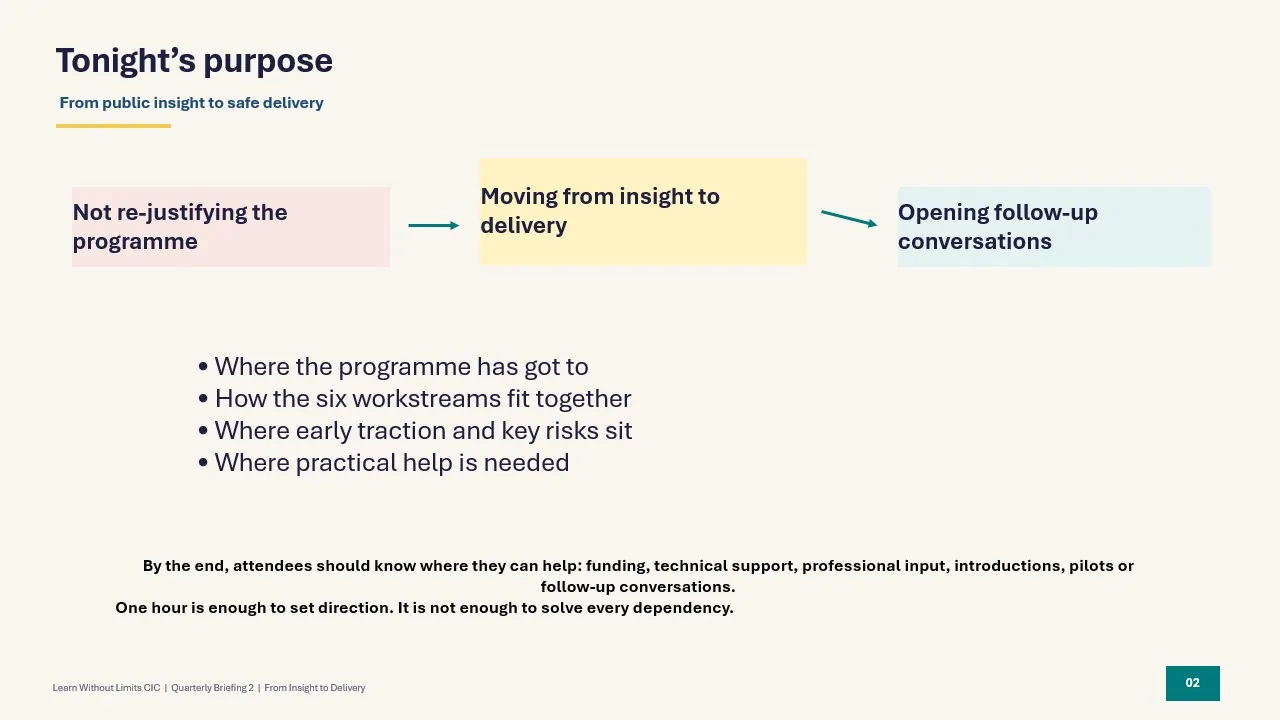
The purpose was not to re-justify why the programme exists. The purpose was to explain where the programme has reached, how the six workstreams fit together, what is already live, where the main delivery risks sit, and what kinds of practical follow-up are now needed.
This was a briefing, not a workshop. One hour is enough to set direction. It is not enough to resolve every dependency.
The core issue: families experience one journey
A central theme of the briefing was the difference between how systems are organised, and how families experience them.
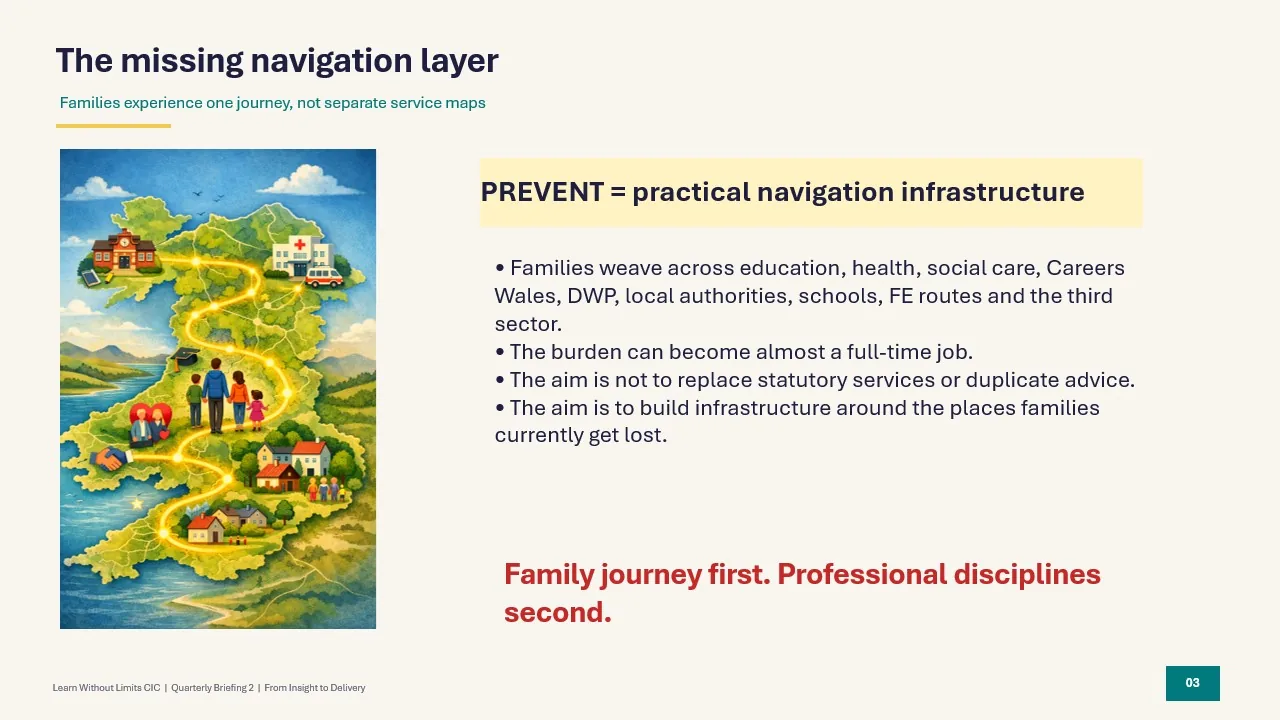
Families navigating Additional Learning Needs, disability, health, education, social care, school breakdown, local authority processes, FE transition, benefits and third-sector support rarely experience those systems as separate service maps. They experience one continuous journey, often while a child or young person is already under pressure.
That journey can become almost a full-time job.
For LWL, PREVENT is the missing navigation layer. It is not designed to replace statutory services or duplicate existing advice. It is designed to help families understand routes earlier, ask better questions earlier, find the right support earlier, and reduce avoidable escalation where possible.
The principle remains:
Family journey first. Professional disciplines second.
Built with families, not designed at a distance
LWL has been built as an iterative programme because parent-carer and young people’s insight needs to shape the model while it is being developed. We have drawn on PRINCE2 Agile principles to support iterative delivery, governance discipline and ease of working with public-sector stakeholders.
The programme is not based on a traditional model where a service is designed from a distance, delivered to families, and then evaluated afterwards. Parent and youth insight is already feeding into the blog, app prototype, podcast themes, Bridge roles, accessibility thinking and future progression pathways.
A repeated message from the community is that consultation without visible change can become exhausting. Lived experience should not be treated as free extraction. It needs to lead to contribution, credit, progression and practical improvement.
This is especially important for young people who have experienced disrupted education, reduced confidence, social withdrawal or limited routes into further education, training or work.
The six workstreams
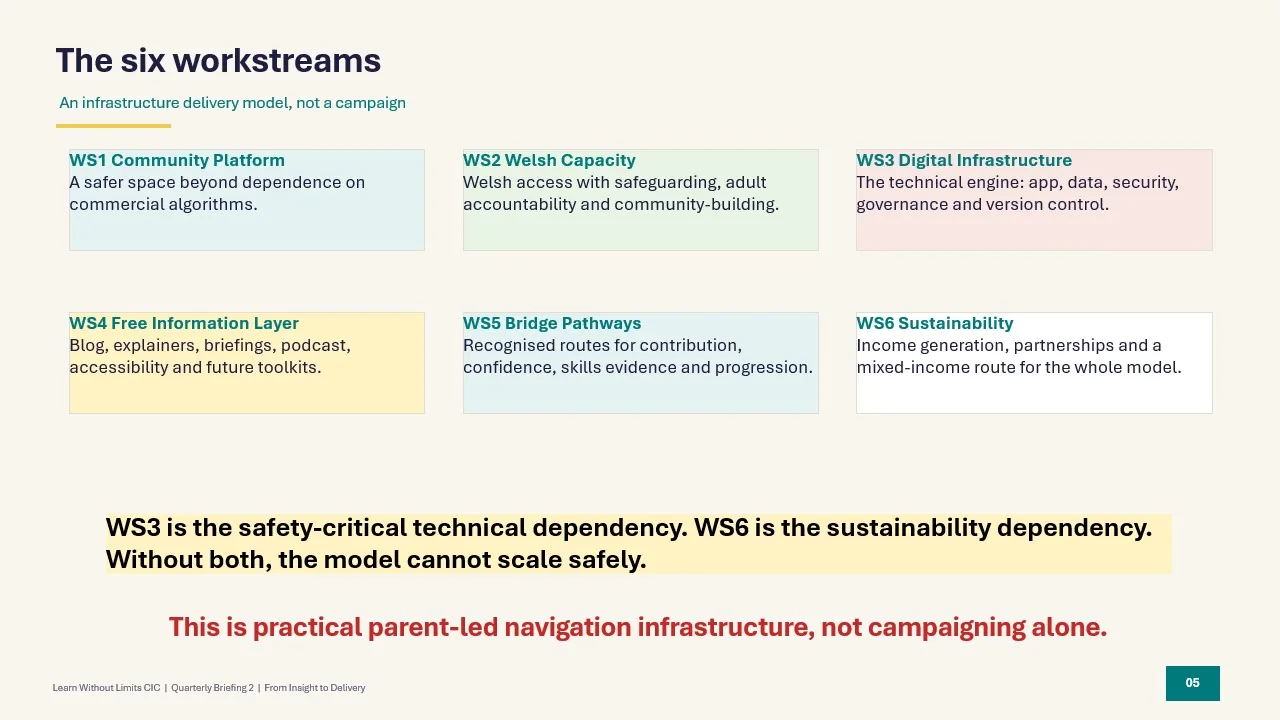
The programme is structured across six connected workstreams.
WS1: Community Platform
LWL currently relies heavily on social media to reach parent carers. However, algorithmic visibility is no longer reliable for calm, localised, non-sensationalist support communities.
The longer-term aim is to develop an owned, governed and safeguarded community platform. This would reduce dependence on commercial algorithms and create a more stable space for parent carers and future partner communities.
This workstream also has a possible sustainability route through carefully governed room-rental for aligned organisations. That would need to be piloted cautiously with one partner first before any wider roll-out. Autistic UK CIC is interested in being our initial pilot partner, subject to funding.
Consensus was reached that this is the right way forward given the direction of commercial social media platforms and the vulnerability of our user community.
WS2: Welsh Language Capacity
The website has been built with bilingual access in mind, but Welsh-language provision currently remains less developed than the English side.
Welsh-language delivery is not just translation. It includes community building, safeguarding-aware moderation, parent communication, content accuracy and routes into the wider programme.
LWL is very clear that our young Welsh-speaking volunteers should not be expected to carry public-facing Welsh-language delivery or safeguarding responsibility. Their education, apprenticeships, college work and wellbeing must come first.
The programme now needs first-language Welsh-speaking adult volunteers, community builders and eventually funded adult capacity to develop this workstream safely. We would expect volunteers who do not already hold suitable safeguarding training to complete online Level 2 safeguarding training, in line with our safeguarding policy.
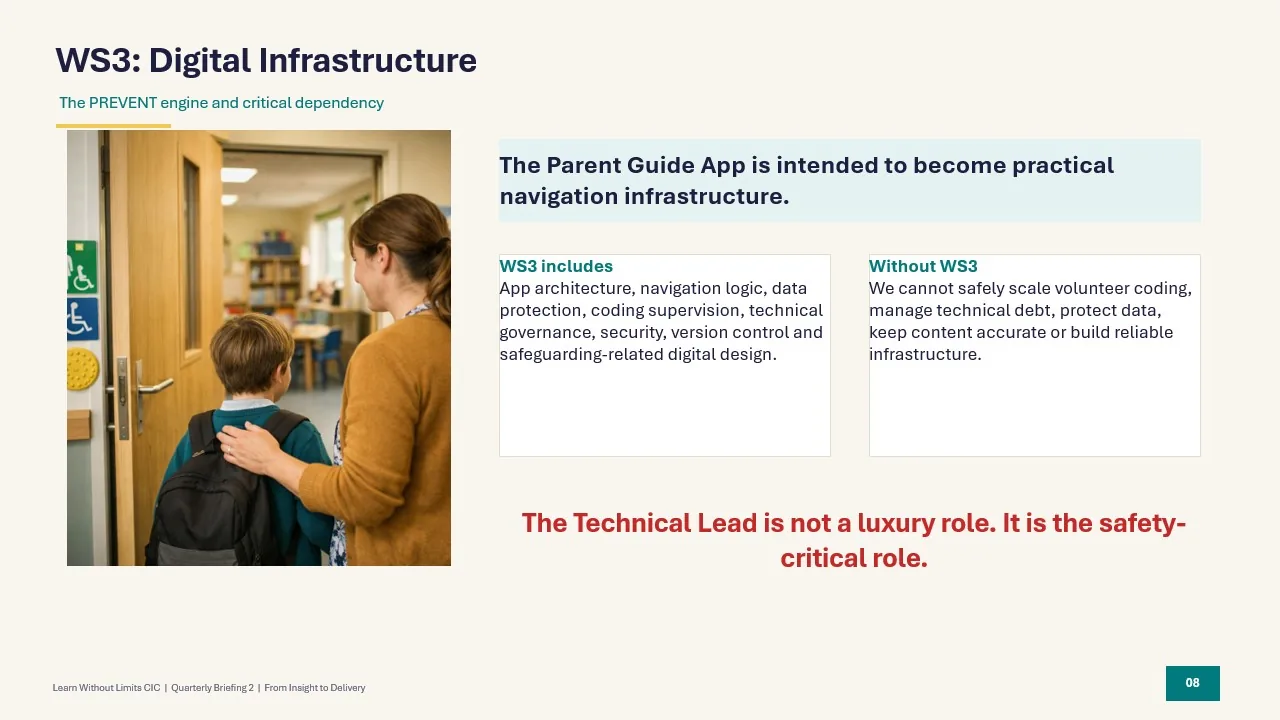
WS3: Digital Infrastructure
WS3 is the safety-critical technical dependency.
This is where the Parent Guide App, navigation logic, data protection, technical governance, coding supervision, security, version control and safeguarding-related digital design sit.
In January 2026 our initial app prototype completed proof-of-concept and user acceptance testing. However, LWL cannot safely scale digital delivery through founder-led technical work alone. Without proper technical governance, the programme risks technical debt, data protection weaknesses and unsafe scaling.
The Technical Lead role is a key critical path requirement. It is the role that makes digital infrastructure safe, governed and sustainable across not just Workstream 3, but the whole programme.
WS4: Free Information Layer
The free information layer is currently the most developed part of the programme.
It includes the blog, public explainers, briefings, parent-facing resources, accessibility work, podcast development and future toolkits. More than 115 public articles now form a live parent-facing knowledge base.
The briefing also highlighted a technical architecture issue. The blog and main website are not currently working together as well as they should for discovery, SEO and user journeys. This matters because free information only works as prevention if families can actually find it at the point of need.
LWL’s first co-produced public project is also developing through this workstream: the LWL ALN Roundtable podcast with Autism’s Hidden Voices Charity. The monthly podcast series is planned to launch publicly in July 2026.
Professional guests will be welcome for future parent-facing roundtables. Possible topics include speech and language therapy, occupational therapy, tribunal processes, school nursing, disability social work, FE transition, Careers Wales, DECLO roles and other areas where parents would benefit from clearer practical explanation in order to better support professionals in helping their child.
WS5: Bridge Pathways
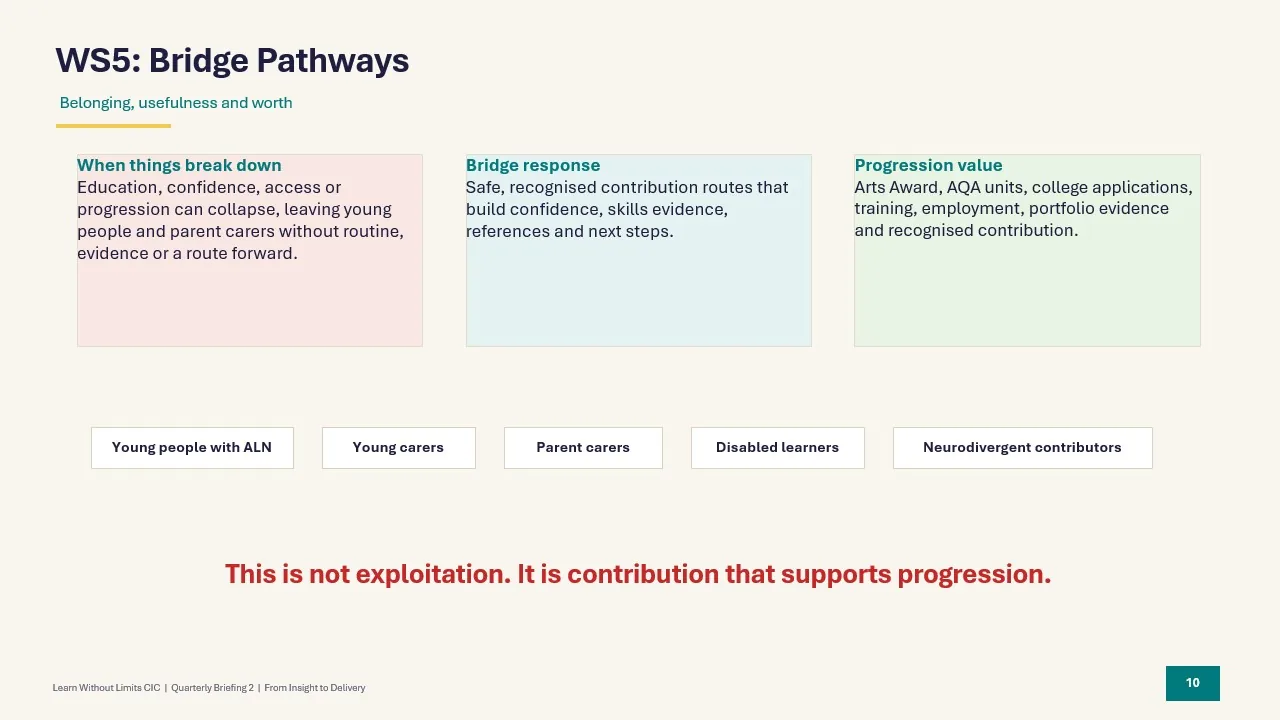
Bridge is designed for the point where education, confidence, access or progression has started to break down.
It creates safe, recognised contribution routes for young people with ALN, young carers, parent carers, disabled learners and neurodivergent contributors. The aim is to support belonging, usefulness, confidence, skills evidence, references and progression.
Bridge is not intended to replace school, college, EOTAS or statutory services. It is supplementary. It is designed to help prevent a downward spiral by creating structured, bounded opportunities with a beginning, middle and end. The briefing also provided useful FE-sector validation that Bridge roles could help young people build digital portfolio evidence for college applications and CVs.
Current and future Bridge opportunities may include creative work, youth artwork, podcast support, digital contribution, coding, community support roles, portfolio evidence, AQA units, Arts Award, Agored Cymru routes or other recognised forms of contribution.
The volunteering model is deliberately designed to be non-exploitative. LWL does not believe disabled young people, neurodivergent people or unpaid parent carers should be expected to volunteer indefinitely without recognition, references, progression evidence or a route forward.
WS6: Sustainability
The briefing was also honest about sustainability.
The aim is not to commercialise crisis support. Informal coffee sessions and quarterly stakeholder briefings will remain free. However, from July 2026, other structured online sessions will usually become low-cost paid events.
The reason is straightforward: free to access is not free to run.
Zoom, the website, the blog, resources, preparation, facilitation, follow-up and safe delivery all carry real costs. From July, paid sessions, even at low cost, will begin testing a modest earned-income route. This is part of WS6: building a mixed-income model so the programme does not become permanently dependent on grants or founder subsidy.
Where cost is a genuine barrier for a family, LWL will consider free places privately on a case-by-case basis.
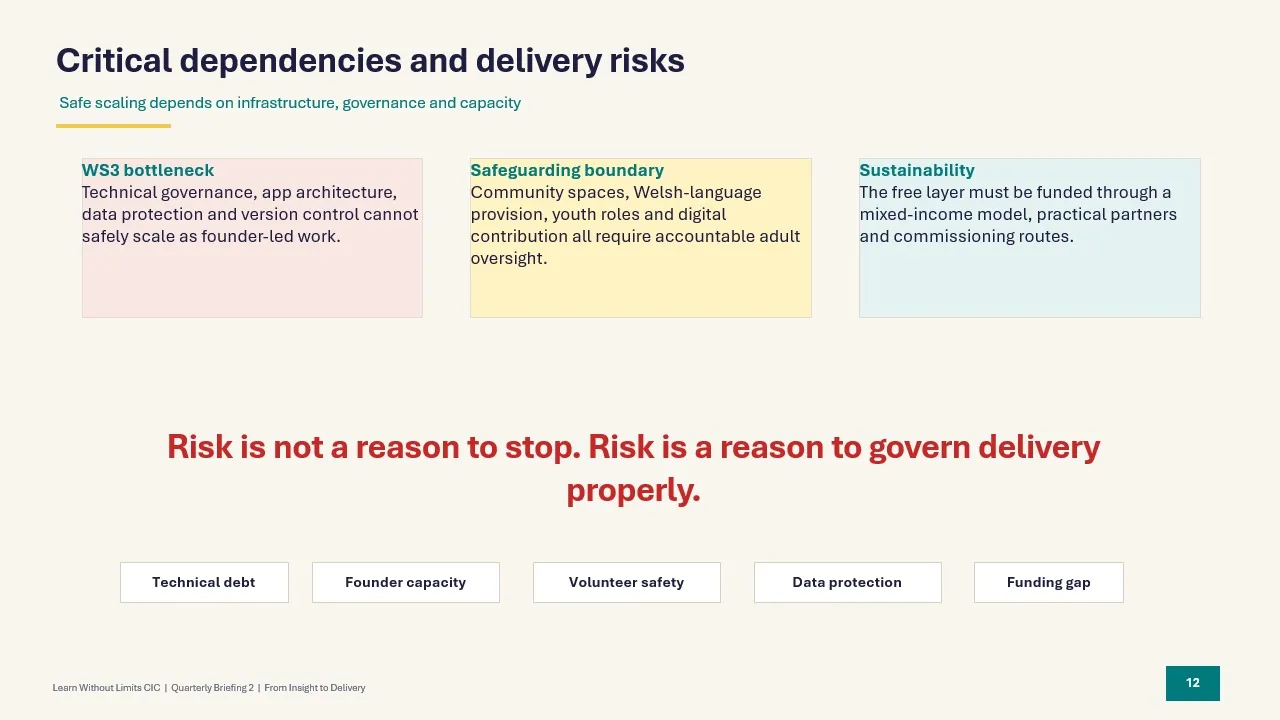
Key delivery risks
The briefing identified several delivery risks.
The most significant are:
- the WS3 technical governance bottleneck;
- lack of infrastructure funding;
- limited core capacity;
- safeguarding boundaries;
- Welsh-language delivery capacity;
- accessibility gaps;
- technical debt;
- dependence on commercial social media platforms;
- the need for earned income to support the free information layer.
Risk is not a reason to stop. It is a reason to govern delivery properly.
Accessibility and rights-based delivery
The discussion included important contributions on accessibility and rights-based delivery, including input from Disability Wales and Joining the Dots.
LWL has already tried to build accessible practice into the website and wider programme, but there is more to do. The discussion confirmed that accessibility must develop beyond basic web accessibility into specialist formats where funding and specialist partners allow.
Areas for future development include:
- Easy Read;
- British Sign Language;
- Makaton;
- Braille;
- accessible formats for different learning and communication needs.
Possible routes for future discussion include Learning Disability Wales / Easy Read Wales, All Wales People First, Wales People First, Barod, Action on Deafness, RNIB, Sense Cymru, National Deaf Children’s Society, AbilityNet and other specialist organisations.
This work will require funding and specialist input. It cannot be done properly through goodwill alone.
What the briefing showed
The June briefing brought together useful parent-carer, early years, FE/post-16, third-sector, disability and cross-party political interest.
School-age experience was represented through parent-carer attendance and community insight. Early years and FE/post-16 voices were also present. However, the next priority is stronger professional input from school-age education and health.
This matters because many preventable escalation points sit at the school-age education and health interface.
Before the September briefing, LWL would welcome help from elected representatives, public bodies, professional networks and partners to bring those voices into the conversation.
Political transition and family impact
The briefing also discussed the practical effect of political and institutional transition.
The briefing reinforced the need for stable, non-partisan navigation infrastructure. Political and institutional transition may be procedurally normal, but families experience its impact in real time. When policy ownership, funding routes or responsibility lines are unclear, families still need to know where to go, what to ask, and how to avoid escalation. LWL’s PREVENT work is designed to sit in that practical gap.
This is not a party-political point.
Families navigating ALN, disability, health, education, social care and post-16 transition do not belong to one party or one electoral cycle. They need practical support regardless of who is in office, which committee holds the brief, or which funding route is currently active.
For that reason, LWL will continue to operate as non-partisan public-benefit infrastructure. We will work with any elected representative, public body, funder, institution or partner willing to support earlier navigation, reduced escalation and better use of public resources.
Collaboration, not co-option
The briefing also restated a boundary that matters to the programme.
LWL is open to collaboration. That may include funded pilots, technical advice, Welsh-language support, professional input, introductions, board-level capacity, public-service digital infrastructure advice, podcast participation or aligned delivery conversations.
To protect the integrity of the model, collaboration also needs clear boundaries.
The programme is not an invitation for unpaid research, unpaid lived-experience extraction, unpaid EDI education, or informal adoption of the model without agreement, safeguarding and resource.
The question is not only:
What can others learn from LWL?
It is also:
What can they bring to help build safely?
Next-stage follow-up
The briefing generated useful discussion, practical suggestions and several follow-up routes.
A one-hour open briefing can help clarify direction, but it cannot resolve every delivery dependency. LWL will therefore focus follow-up on the areas where there is clear alignment: FE/post-16 and Bridge pathways, accessibility, Welsh-language capacity, technical governance, funding routes, school-age professional input, health and social care.
The public write-up, slides and future briefing dates will remain available so that anyone interested can follow the work transparently. Direct follow-up will be prioritised where there is a practical next step.
Actions following the June briefing
The immediate actions from the June briefing are:
- Publish this public write-up and add it to the LWL About page.
- Share the write-up with attendees, apologies and invited stakeholders.
- Make the briefing slides available as part of the public record.
- Publish the fourth quarterly Governance Report in early July 2026.
- Attend the planned Medr follow-up meeting in July.
- Follow up with Swansea Council Business Growth Grants team regarding match-funding routes for WS3.
- Continue exploring FE/post-16 and Bridge pathway conversations.
- Follow up on accessibility contacts for Easy Read, BSL, Braille and other access formats.
- Seek professional guests for the LWL ALN Roundtable podcast.
- Recruit Welsh-speaking adult volunteers willing to support Welsh-language development safely.
- Strengthen school-age professional, health and social care input before the September briefing.
- Continue building earned-income routes from July 2026 to reduce reliance on founder subsidy.
Next briefing: September 2026
The next quarterly briefing is already available to book through Eventbrite:
Book LWL Quarterly Briefing 3: Emerging Parent Insight and ALN System Navigation
For September, LWL particularly wants to strengthen input from:
- school-age education professionals;
- health;
- social care;
- FE/post-16 transition routes;
- funders and infrastructure partners;
- Welsh-language capacity partners;
- accessibility specialists;
- technical governance and civic-tech contacts.
The June briefing confirmed that the need is clear and the model is developing. It also showed that the next stage requires targeted practical follow-up.
LWL will continue publishing briefing write-ups and governance updates publicly so that anyone interested can follow the work transparently. Future briefing dates will be available through Eventbrite for those who would like to attend. Our fourth quarterly Governance Report will be available via the About page of our website as usual in the first week of July.
PowerPoint slides used in the briefing are available on request.
The door remains open.
The work will continue with those willing to help build it safely.
Post-Event Information Update (20th June 2026)
Following the briefing, Learn Without Limits CIC received a response to a Freedom of Information request relating to recorded costs associated with ALN consultation, engagement, research and evaluation activity.
Although the request did not yield the cost figures originally sought, the response highlighted the complexity of reconstructing a comprehensive picture of these costs. Welsh Government advised that even a significantly narrowed request would exceed the statutory cost limits and require substantial manual work across historic records, tenders and contracts.
For Learn Without Limits CIC, this reinforces an important point.
Prevention depends not only on good intentions and collaboration, but also on the ability to understand where resources are being invested and where pressures are emerging.
The response suggests that the costs associated with ALN reform have not been tracked in a way that allows them to be easily understood, compared, or scrutinised across the system.
As a prevention-led programme, we believe improving visibility of costs and outcomes is important for learning from reform and identifying where earlier intervention can reduce later pressures.