
Where Our Model Was Right, and Where Reality Has Been Harder
A reflective assessment of the Learn Without Limits Prevent → Bridge → Progress model after moving from concept into live delivery.
Over the past year, Learn Without Limits CIC has increasingly described its work using a simple framework:
Prevent → Bridge → Progress
This model was developed through our internal programme architecture in November 2025 and introduced publicly through our March 2026 cross-sector briefing on prevention, bridging and progression within the ALN system.
This reflection was also informed by Tina Seelig’s Innovation Engine model, which explores how internal and external conditions interact to shape innovation capacity.
We used the model because it helped us look beyond single-point explanations and examine how culture, knowledge, resources, platform environment and imagination were interacting in practice.
This is not a claim that a business innovation model maps perfectly onto community infrastructure. It is a useful lens for examining interacting conditions.
The programme has also attempted to follow staged and iterative delivery principles aligned broadly with PRINCE2 Agile thinking: incremental delivery, visible risk management, continuous reflection, operational learning and adaptation based on real-world feedback rather than static assumptions.
The programme’s evolution toward preventative infrastructure did not emerge suddenly. Earlier public reflections had already explored themes around knowledge infrastructure, lived experience systems design, changing volunteer realities, digital-first navigation and system strain in Wales. This article therefore reflects not only on operational delivery, but on a line of thinking that has been developing publicly over time.
At first, the Prevent → Bridge → Progress framework existed mainly as programme architecture. It described repeated patterns we had observed across years of parent-led community activity involving families navigating Additional Learning Needs, school breakdown, exclusion, Elective Home Education, emotionally based school avoidance, delayed support pathways and post-16 uncertainty.
Since then, parts of the model have moved from concept into live public delivery.
What began as early-stage infrastructure planning now includes:
- a bilingual public website
- a growing free information platform
- more than 100 publicly available guidance and systems-navigation articles
- structured stakeholder briefings
- public governance reporting
- prototype digital navigation infrastructure
- early bridging pathway planning
- growing cross-sector engagement
This has happened in a wholly volunteer environment.
To date, nobody involved in building this programme has received payment for this work.
As this infrastructure has become operational, reality has started testing the model itself.
Some working assumptions were tested and held up well. Others exposed harder operational realities than the architecture alone could show.
Reflecting against the Innovation Engine model
The more we reflected on the programme against the Innovation Engine framework, the clearer it became that many of the pressures we were experiencing were not isolated operational problems.
They were interacting conditions.
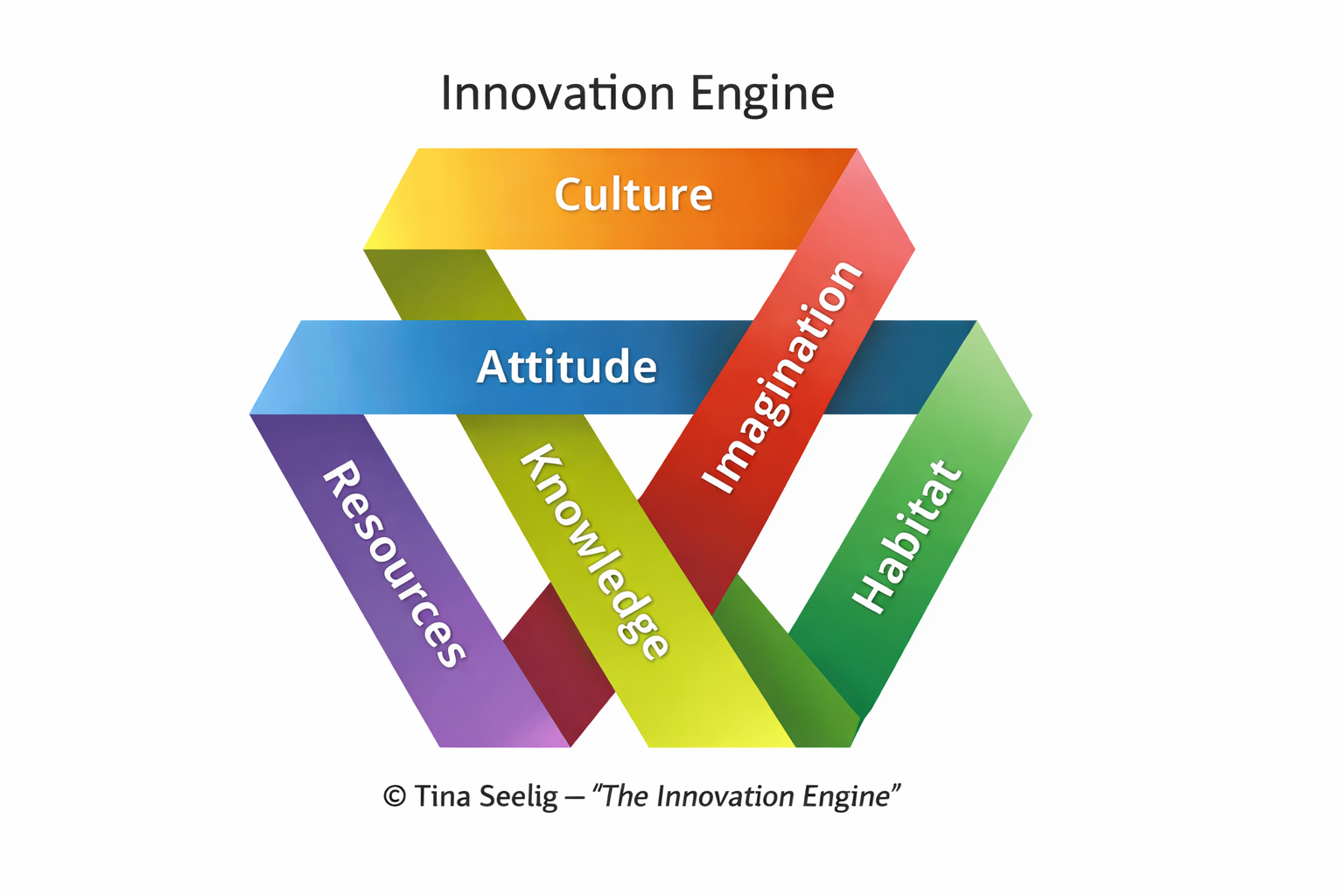
Figure 1: Tina Seelig’s Innovation Engine model, used here as a reflective lens for considering how internal and external conditions interact during community-led programme development.
| Innovation Engine element | What this revealed in Learn Without Limits |
|---|---|
| Culture | Parent-led trust, safeguarding boundaries and a non-exploitative volunteer ethos matter as much as formal structure. |
| Attitude | Moving beyond reactive crisis response required us to ask whether another delivery model was possible. |
| Knowledge | Aggregated lived experience became practical navigation guidance, blog content and programme architecture. |
| Resources | Funding, technical capacity, moderation time and paid roles remain the limiting conditions. |
| Habitat | Facebook enabled early community growth but is not stable enough for long-term safeguarded infrastructure. |
| Imagination | Prevent → Bridge → Progress created a way to think beyond individual casework toward system navigation. |
This table is not presented as a formal evaluation framework. It is a reflective lens for understanding how different conditions have interacted during live delivery.
Why the model emerged in the first place
Learn Without Limits CIC continues to value traditional one-to-one support, advocacy and casework approaches.
Many families navigating crisis require direct human support, and skilled frontline practitioners remain essential across education, health, social care, community organisations and parent-led groups across Wales.
Learn Without Limits CIC originally provided direct one-to-one peer support and navigation help within the community itself. However, over time the volume, complexity and urgency of requests became increasingly unsustainable for a wholly voluntary group made up largely of people with their own caring responsibilities.
This forced us to confront a difficult question:
Was there another way to support families earlier and at greater scale without simply recreating an overstretched crisis-response model inside a volunteer community?
The Prevent → Bridge → Progress framework emerged partly from that question.
More families were reaching crisis point.
More children were experiencing disrupted access to education.
More young people were at risk of becoming not in education, employment or training.
More parent carers were being forced out of employment because their child’s educational journey had become unstable, unsafe or impossible to sustain through ordinary routes.
Wider system pressure was also becoming increasingly visible publicly. Our April 2026 reflection on Audit Wales’ ALN findings highlighted concerns around system strain, incomplete demand visibility, delayed support pathways and operational pressure across ALN delivery in Wales.
Welsh Government statistics show that the proportion of young people aged 16 to 24 in Wales who were NEET was 17.0% in the year ending September 2025, up 6.2 percentage points over the year. Senedd Research has also highlighted that pupil absence in Wales remains significantly above pre-pandemic levels.
The more we observed these patterns, the harder it became to ignore a fundamental tension:
Even highly skilled casework systems struggle when increasing numbers of families are reaching crisis point simultaneously without strong preventative navigation infrastructure operating earlier upstream.
The model was not designed to replace frontline support.
It was designed around a different question:
What infrastructure might help fewer families reach avoidable crisis points in the first place?
The original logic behind the model
The model eventually evolved into three interconnected layers.
Prevent
Supporting families to understand and navigate the system earlier, before issues escalate.
This includes practical information, early guidance, community knowledge-sharing and digital navigation tools.
Bridge
Providing short-term support and shared learning where education has begun to break down.
This includes maintaining engagement with learning, reducing isolation, supporting wellbeing, stabilising circumstances while longer-term provision is arranged and helping families understand possible routes through the gap.
This is not about Learn Without Limits becoming a formal EOTAS provider.
It is about temporary continuity.
Bridge also includes parent carers who may need routes back toward confidence, volunteering, skills and work after being forced out of the labour market by their child’s disrupted educational journey.
Bridge is the stabilising layer between breakdown and longer-term handover.
Progress
Progress describes the intended handover point.
For children and young people, this may mean reconnecting with statutory education, further education, training, employment, specialist provision or other appropriate long-term systems.
For parent carers, this may mean moving from confidence-building and volunteering toward paid work, training or wider economic participation.
Progress usually sits outside the direct delivery remit of Learn Without Limits CIC.
Learn Without Limits is not trying to become the destination.
The programme is trying to reduce avoidable escalation, support temporary continuity and improve the handover back into systems that should already exist.
Where the model was right
1. The demand for preventative navigation support was far greater than expected
One of the clearest lessons from live delivery has been the scale of demand for practical, preventative information.
The free information platform initially began as a modest knowledge-sharing project.
However, sustained publication activity quickly revealed that families were actively searching for:
- explanations of ALN processes
- EOTAS information
- transition guidance
- exclusion pathways
- sensory regulation support
- post-16 clarification
- home education navigation
- FE access information
- practical next steps during periods of instability
Importantly, many families were not primarily looking for conflict.
They were looking for clarity.
This reinforced one of the central assumptions within the Prevent layer of the model: that improving understanding earlier may reduce escalation later.
The growth of the Learn Without Limits blog from approximately 50 articles at the point of the November 2025 programme architecture to more than 100 publicly available articles within a relatively short timeframe further reinforced the scale of unmet demand for accessible navigation support.
This demand was visible not only through readership patterns, but through repetition itself.
The same themes appeared repeatedly across unrelated families:
- confusion around rights
- uncertainty around transitions
- breakdown during placement instability
- fear around exclusion
- post-16 navigation difficulties
- uncertainty around EHE and EOTAS
- lack of clarity around bridging routes
Over time, this repetition became difficult to dismiss as isolated anecdotal experience.
This broader shift from reactive Facebook support community toward structured knowledge infrastructure was explored further in our earlier article, From Facebook Community to Knowledge Infrastructure.
2. The risks of third-party platform dependency were real
The original architecture identified reliance on commercial social platforms as a long-term safeguarding and continuity risk.
Live delivery has confirmed this repeatedly.
Third-party platforms enabled early community growth, but they also introduced structural problems:
- algorithm-driven visibility changes
- emotional amplification dynamics
- reduced moderation control
- inconsistent reach
- engagement volatility
- safeguarding limitations
- difficulty maintaining calm, reflective discussion spaces
Large social media platforms are increasingly shaped by engagement-driven systems that can reward emotionally charged, polarising content over calm, reflective, safeguarding-aware navigation support.
This is not just an internal concern. Ofcom-commissioned research has examined how recommender system design can increase or decrease the likelihood of users encountering illegal and harmful content. UK parliamentary reporting has also examined the role of algorithms in amplifying harmful and misleading content.
There is also a practical concern.
The abrupt disappearance, disabling or loss of support-based groups elsewhere creates a genuine sense of trepidation that our own tenure on any external platform may also prove temporary. Meta’s own guidance confirms that Facebook groups can be disabled or subject to appeal processes where platform rules are considered to have been breached.
For a community like ours, that matters.
If a group disappears overnight, the loss is not merely technical.
It can mean the sudden disappearance of peer connection, informal navigation history, moderation labour, community trust and years of accumulated practical knowledge.
The proposed move toward owned, moderated infrastructure aligned with safeguarding and governance requirements now appears significantly less theoretical than it did when first drafted.
In many ways, the instability of existing platforms has validated the original concern.
3. Founder dependency was identified correctly from the outset
The programme architecture identified founder dependency as a serious operational vulnerability from the beginning.
Live delivery has not revealed this risk.
It has confirmed that the programme identified it correctly from the outset.
As activity increased, responsibility concentrated around a relatively small number of people simultaneously managing:
- governance
- safeguarding awareness
- strategic planning
- content production
- moderation
- stakeholder engagement
- partnership development
- technical oversight
- delivery sequencing
- systems analysis
This concentration of responsibility is not sustainable indefinitely.
Importantly, the original governance model did not treat this as personal failure or organisational weakness.
It treated it as infrastructure risk.
That distinction matters.
Many small organisations normalise founder overload until collapse occurs.
The Learn Without Limits governance model attempted to identify this risk openly at an earlier stage.
The harder lesson is not that founder dependency was missed.
It was not.
The harder lesson is that systems are still poorly set up to hear and respond quickly to lived experience communities when those communities identify infrastructure risks before collapse occurs.
This challenge was also explored in our earlier article, The Changing Landscape of Volunteering, particularly around the growing tension between increasingly complex community needs and older volunteer delivery assumptions.
4. Technical governance became more important as the information layer expanded
One of the strongest assumptions within the original architecture was that technical governance would become increasingly critical once navigation infrastructure started scaling.
Again, this proved accurate.
As publication output, information complexity and engagement increased, several realities became obvious very quickly:
- legislation changes regularly
- terminology evolves
- guidance shifts
- safeguarding expectations increase
- accessibility requires active oversight
- digital continuity requires maintenance
- information accuracy becomes progressively harder to sustain at scale
The original programme architecture proposed a dedicated Technical Lead role because founder-led technical oversight was never considered sustainable long term.
At the time, this may have appeared overly ambitious for a small organisation.
In practice, live delivery suggests the opposite.
The more preventative infrastructure grows, the more governance and technical stewardship become necessary.
This became particularly visible during our wider reflections on the need for a digital-first navigation layer within Wales, especially where fragmented systems, transition instability and uneven access to practical guidance were already creating barriers for families before formal intervention pathways had even begun.
Learn Without Limits has already migrated its blog from Blogger, a proprietary publishing platform, to GitHub, an industry-standard development and version-control environment. We also undertook user acceptance testing on our navigation prototype tool in November 2025.
However, scaling digital infrastructure involving vulnerable families, safeguarding-sensitive information and navigation data requires proper professional oversight, data protection discipline, secure development practice and supervised coding capacity.
This is not an area where “good enough” amateur delivery is acceptable.
We have enough technical capability to prototype, test and learn. We also have enough governance maturity to know where volunteer-led technical delivery must stop and properly supervised development must begin.
The more we assessed the programme against the systems-oriented lens described within the Innovation Engine discussion, the clearer it became that many of the pressures we were experiencing were not isolated operational problems.
They were interacting conditions:
- volunteer capacity
- platform dependency
- safeguarding expectations
- fragmented data
- technical governance
- financial sustainability
- community trust
- organisational resilience
All influencing one another simultaneously.
Where reality has been harder
1. Prevention is easier to describe than to sustain
One of the most difficult operational realities has been the tension between widespread rhetorical support for prevention and the practical difficulty of funding preventative infrastructure consistently.
The Learn Without Limits model aligns strongly with the prevention principles embedded within the Well-being of Future Generations (Wales) Act.
However, translating preventative language into operational sustainability has proven far harder than anticipated.
Part of the difficulty appears structural.
Many funding systems remain significantly more comfortable supporting reactive interventions, visible frontline delivery, geographically narrow activity, short-term measurable outputs and traditional service models.
Preventative infrastructure often looks different.
It is:
- slower
- governance-heavy
- cross-sectoral
- difficult to categorise cleanly
- harder to measure in immediate terms
- dependent on continuity and iteration over time
This creates a persistent tension between what appears strategically necessary and what existing systems are currently designed to fund.
2. The Missing Middle: When Prevention Is Recognised but Not Yet Structurally Funded
There is a systemic funding architecture issue around preventative navigation infrastructure.
Across Wales, there is growing acknowledgement that families are struggling to navigate fragmented systems, repeated transitions, and increasingly complex support pathways. However, funding structures still tend to favour either short-term reactive delivery or established organisational continuity over the slower work of building connective infrastructure between systems.
In practice, this can leave emerging preventative models in an awkward position: visibly useful to families, increasingly relevant to professionals, but difficult to fit neatly into traditional funding categories because the value lies not in one isolated intervention, but in improving how multiple parts of the system connect, communicate, and respond over time.
This is particularly important in areas such as ALN, safeguarding, attendance, mental health, home education, and transition support, where families often move repeatedly between services that may each hold only part of the wider picture.
Prevention infrastructure is still infrastructure.
It requires:
- governance;
- coordination;
- trusted information pathways;
- digital systems;
- safeguarding awareness;
- partnership-building;
- and long-term continuity.
Yet these connective layers can be harder to fund than visible frontline interventions, even where the absence of good navigation infrastructure may contribute to escalation, duplication, conflict, or avoidable crisis further downstream.
For Learn Without Limits CIC, this is particularly important because the technical governance layer cannot safely be built through piecemeal, very short-term or constantly changing labour.
Some parts of a programme can be developed gradually through volunteer input, small grants, phased activity or carefully stacked capacity. Technical governance is different. Once a platform begins handling structured navigation pathways, safeguarding-sensitive insight, user journeys, referral routes, permissions, analytics, or any form of data governance, the risks become much higher.
Trying to build that layer through fragmented short-term support can increase overall costs rather than reduce them. It can also create technical debt, inconsistent decision-making, weak documentation, unclear accountability, and avoidable data-governance gaps.
For a prevention model to operate safely at scale, this layer needs sustained paid technical leadership, not a series of disconnected fixes.
3. Data fragmentation makes the cost-benefit case harder than expected
A further challenge has been the fragmentation of available data, particularly around 16+ transitions.
This matters for two reasons.
First, fragmented data can make children, young people and economically affected families less visible to the systems that should be planning around them.
When a young person is out of school, moving between education statuses, home educated, awaiting FE progression, not in employment, or only partially visible to services, the full picture can become difficult to see.
Second, weak data makes the cost-benefit case harder to build.
At programme design stage, we had assumed that it would be relatively straightforward to compare the cost of preventative infrastructure with downstream costs linked to exclusion, tribunal escalation, prolonged disengagement, NEET outcomes, and family economic disruption.
In practice, the available data is more fragmented than expected.
This makes it harder to evidence the cumulative cost of late intervention, even where families’ lived experience strongly suggests that the costs are being carried somewhere: by schools, local authorities, health systems, tribunals, parent carers, employers, and young people themselves.
This is now one of the areas where the model has become more strategically important, but also harder to evidence than we had hoped.
4. Demand continues to outpace capacity
Perhaps the clearest lesson from live delivery has been the scale of unmet navigation need.
Questions continue emerging across:
- exclusion
- EOTAS
- school breakdown
- IDP disputes
- transition instability
- assistive technology
- FE access
- post-16 continuity
- sensory regulation
- emotionally based school avoidance
- home education pathways
- safeguarding concerns
The repetition itself is significant.
Many families appear to be encountering the same breakdown points repeatedly, often while attempting to navigate highly fragmented systems under considerable emotional strain.
However, recognising need and sustainably meeting need are not the same thing.
This remains one of the programme’s central unresolved tension points.
What we believe more strongly now
Prevention infrastructure is still infrastructure
Preventative systems require:
- governance
- safeguarding
- moderation
- technical oversight
- accessibility planning
- continuity management
- sustainability planning
- partnership coordination
They are not simply information projects.
Bridge is about temporary continuity, not permanent substitution
This distinction is fundamental.
Learn Without Limits is not seeking to replace statutory services, become a formal EOTAS provider or hold long-term responsibility for children’s education.
The Bridge layer exists because breakdowns happen before systems are ready to respond.
Families need clearer navigation during that gap.
Young people need routes that reduce isolation and support re-engagement.
Parent carers need pathways back toward confidence, skills, volunteering and work where disrupted education has pulled them out of the labour market.
But the intended direction remains handover back into appropriate systems.
Community insight has strategic value when handled ethically
One of the strongest aspects of the programme has been the ability to observe recurring patterns across large numbers of families over time.
While no individual family experience represents the whole system, aggregated pattern recognition repeatedly highlights:
- recurring friction points
- repeated transition instability
- navigation confusion
- delayed escalation patterns
- structural gaps between systems
Handled proportionately and ethically, this type of insight may have genuine preventative value.
This wider idea of lived experience communities shaping practical solutions was explored further in our earlier article, When Communities Design the Solution.
Prevention is operationally harder than crisis response
Crisis systems generate immediate visibility because harm has already escalated.
Preventative systems operate differently.
When prevention functions well:
- fewer situations escalate
- transitions become less chaotic
- understanding improves earlier
- families navigate systems with greater clarity
- avoidable conflict may reduce
These outcomes are slower, quieter and significantly harder to measure in immediate terms.
That does not necessarily make them less important.
Conclusion
The Learn Without Limits Prevent → Bridge → Progress model is still evolving.
Some areas remain fragile.
Some remain incomplete.
Others are still early-stage.
However, moving from concept into live delivery has confirmed several important assumptions:
- families are actively seeking preventative navigation support
- more families are reaching crisis point
- fragmentation between systems remains significant
- technical governance matters
- third-party platform dependency creates genuine risk
- bridging pathways require substantial infrastructure
- data fragmentation makes cost-benefit analysis harder than expected
- founder dependency is a real operational vulnerability
- preventative systems are difficult to stabilise without sustained support
Most importantly, the programme is no longer testing whether these pressures exist.
The pressures are already visible.
The question now is not whether preventative infrastructure is needed. The evidence of need is already visible. The question is whether communities that identify those risks early are given the professional capacity to stabilise solutions before wholly volunteer systems are overwhelmed by the demand they were never resourced to carry.
Related articles
- From Facebook Community to Knowledge Infrastructure
- When Communities Design the Solution
- The Changing Landscape of Volunteering
- Prevention, Bridging and Progression in the ALN System
- Audit Wales says the ALN system is under strain
- Wales needs a digital-first navigation layer
References
[1] T. Seelig, inGenius: A Crash Course on Creativity. New York, NY, USA: HarperCollins, 2012.
[2] T. Seelig, “The Innovation Engine,” Stanford eCorner.
[3] AXELOS, “PRINCE2 Agile® Guidance,” AXELOS Ltd.
[4] Learn Without Limits CIC, “Prevention, Bridging and Progression in the ALN System,” Mar. 18, 2026.
[5] Learn Without Limits CIC, “From Facebook Community to Knowledge Infrastructure,” Mar. 13, 2026.
[6] Learn Without Limits CIC, “When Communities Design the Solution,” Mar. 13, 2026.
[7] Learn Without Limits CIC, “The Changing Landscape of Volunteering,” Jan. 14, 2026.
[8] Learn Without Limits CIC, “Audit Wales says the ALN system is under strain. Families in Wales will not be surprised,” Apr. 8, 2026.
[9] Learn Without Limits CIC, “Wales needs a digital-first navigation layer.”
[10] Welsh Government, “Young people not in education, employment or training (NEET): October 2024 to September 2025,” Jan. 29, 2026.
[11] Senedd Research, “Not in school: pupil absence,” Nov. 1, 2024.
[12] Ofcom, “Evaluating recommender systems in relation to the dissemination of illegal and harmful content in the UK,” Jul. 6, 2023.
[13] UK Parliament, “Social media, misinformation and harmful algorithms,” Oct. 17, 2025.
[14] Meta, “Appeal Facebook’s decision to disable your group or remove content.”
[15] Learn Without Limits CIC, “Bridge.”
[16] Learn Without Limits CIC, “About.”
[17] Learn Without Limits CIC, “About.”