
Prevention, Bridging and Progression in the ALN System
What happened at our first cross-sector community briefing
Learn Without Limits CIC hosted its first cross-sector community briefing, bringing together voices across education, health, community support and lived experience.
What was planned as a short 40-minute session became something more significant:
the start of a shared conversation about where the ALN system is breaking down and how earlier support can change outcomes for families.
🌱 From lived experience to system insight
This work is grounded in lived experience from a community of 950+ parent carers across Wales.
What was shared in the session reflects consistent patterns seen across that community:
- unmet or unidentified ALN needs
- growing school conflict
- reduced timetables and exclusion risk
- placement breakdown and disengagement
These are not isolated cases.
They form a recognisable escalation pathway when families are not supported early enough.
⚠️ Where the system breaks down
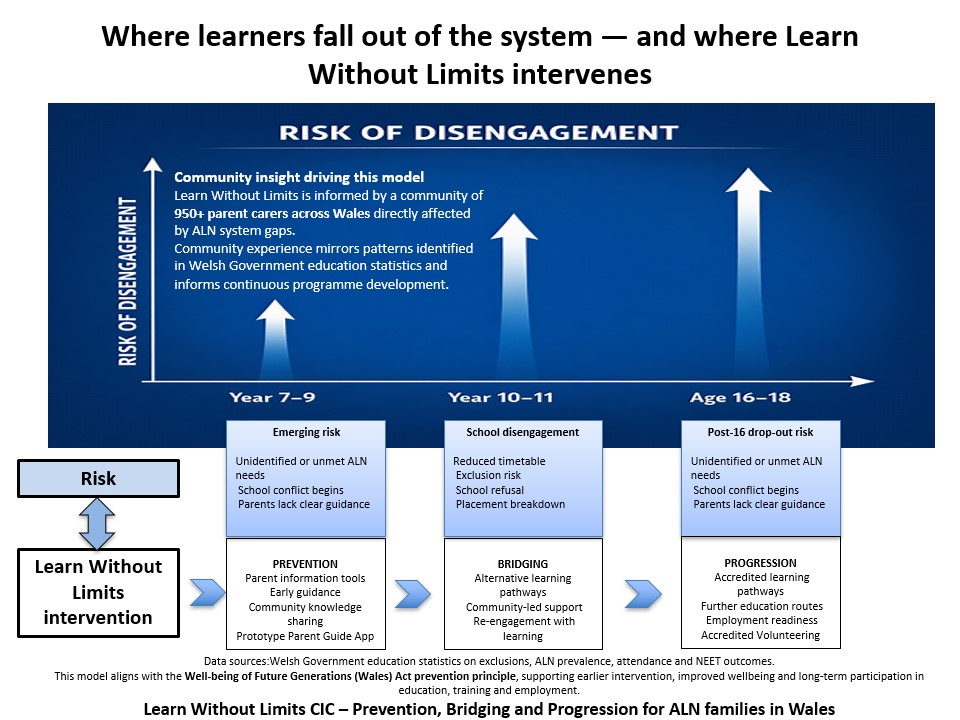
Where learners fall out of the system and where Learn Without Limits intervenes across key stages.
A key insight from the session was how often families are left trying to piece together fragmented information, often months after they needed it.
When you are supporting a child with additional needs, that delay matters.
It is often the difference between:
- early resolution
- full escalation into dispute or crisis
🔍 Why early navigation matters
Discussion focused on what changes when families are supported earlier.
Not through additional services, but through:
- clear, practical guidance
- understanding of rights
- confidence to engage with schools and local authorities
When this happens, the impact is significant:
- reduced escalation to formal disputes
- earlier resolution of issues
- lower demand on statutory services
- reduced need for crisis intervention
This is not about adding complexity to the system. It is about making what already exists easier to navigate, earlier.
🧭 The Prevent → Bridge → Progress model
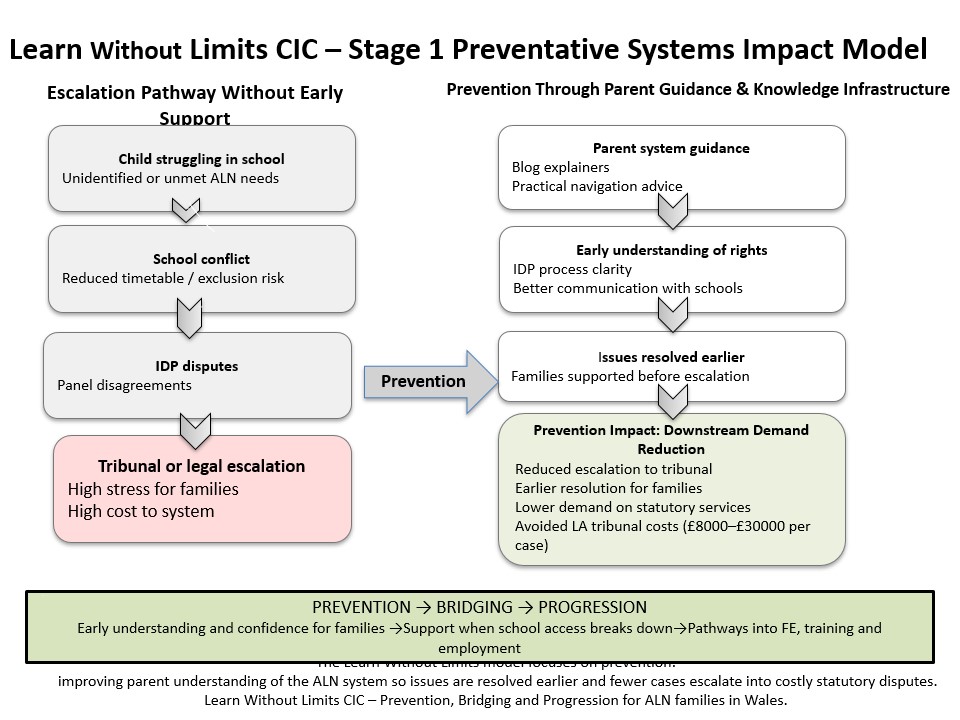
Early guidance reduces escalation, improves outcomes and lowers demand on statutory services.
The session introduced the Learn Without Limits approach, focused on key navigation pinch points within the system:
🟢 Prevent
Supporting families to understand and navigate the system earlier, before issues escalate.
🟡 Bridge
Providing short-term support and shared learning where education has begun to break down.
🔵 Progress
Enabling pathways back into education, training and longer-term outcomes.
This typically involves return to statutory education or further education provision, which sits outside the direct delivery of Learn Without Limits.
Learn Without Limits does not replace statutory services.
It strengthens how families engage with them earlier, and more effectively.
🌉 When education breaks down
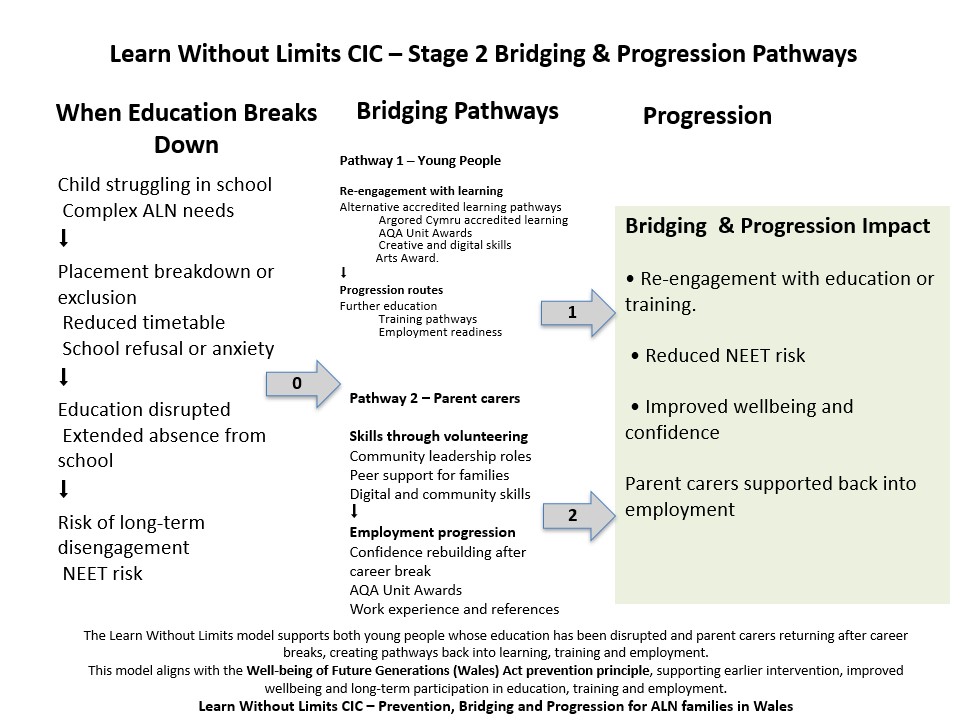
Bridging pathways support re-engagement with learning and progression into education, training and employment.
For some families, challenges escalate despite early intervention.
Discussion explored the role of bridging support in these situations:
- maintaining engagement with learning
- reducing isolation
- supporting wellbeing
- stabilising circumstances while longer-term provision is arranged
This is not a replacement for statutory provision.
It is a stabilising phase that helps prevent long-term disengagement.
🧠 More than a project: this is infrastructure
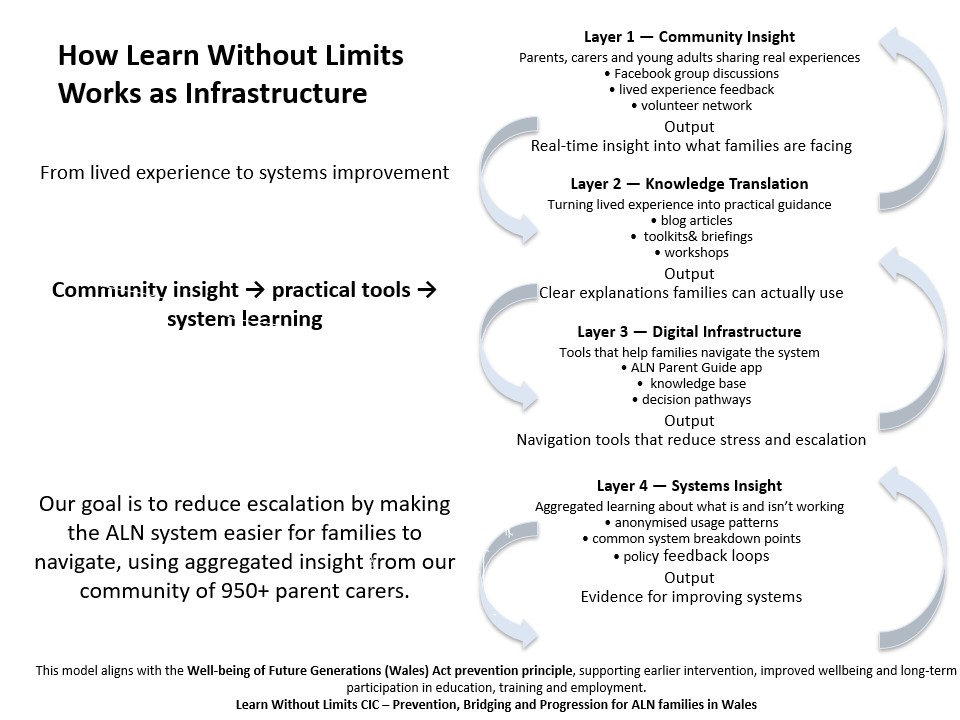
Learn Without Limits operates as a continuous loop: community insight, practical tools and system learning.
A key insight from the session was that Learn Without Limits is not a one-off intervention.
It is an evolving, community-led infrastructure.
The model operates by:
- capturing real-time lived experience
- translating that into practical tools and guidance
- feeding insight back into wider system understanding
This creates a continuous loop:
community insight → practical tools → system learning
🤝 Cross-sector convening in practice
One of the most significant aspects of the session was the mix of perspectives in the room.
Parent carers, practitioners and professionals engaged in a shared conversation around the same system challenges, something that does not often happen in practice.
The discussion included input from:
- disability sector organisations
- health and education practitioners
- civil service perspectives
It was particularly valuable to see the model validated beyond lived experience alone.
This kind of cross-sector dialogue is essential if preventative approaches are to move from concept into practice.
This was not just a briefing.
It was the beginning of a cross-sector conversation.
⚡ Why this moment matters
What became clear during the session is that many of the most challenging situations arise before formal systems fully engage.
Which means:
if we want to reduce escalation, we have to intervene earlier
📅 What happens next
This session marks the first in a planned series of quarterly briefings.
The next open-call community briefing will take place in:
June 2026
🔧 From conversation to collaboration
Following the briefing, Learn Without Limits will begin a series of monthly cross-sector collaboration sessions.
These sessions will focus on:
- specific delivery modules within the programme
- practical testing of approaches
- real-world implementation
This ensures that the programme continues to be:
- grounded in lived experience
- informed by professional insight
- developed through real-world application
This work is not static.
It is being actively built, tested and refined in collaboration with those working across the system.
🚀 Get involved
We are actively looking to collaborate with:
- professionals working across ALN, health and social care
- education practitioners
- policy and research partners
- technical collaborators
- funders and sponsors aligned with early intervention
There is a clear appetite for doing things differently, and earlier.
📩 Want to be part of the next session?
This is just the beginning.
Make sure you are part of the next conversation in June.
📎 Further information
Slides and full briefing materials are available on request.
📚 Related reading
This work builds on a series of articles exploring the challenges families face within the ALN system and how community-led solutions can emerge: